Authorized:











Curved

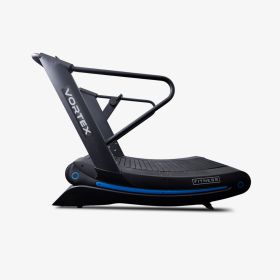
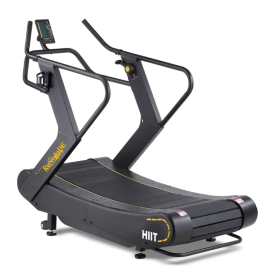
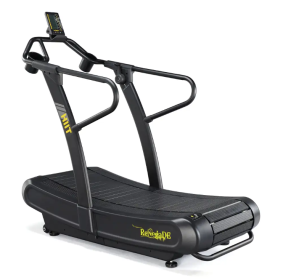

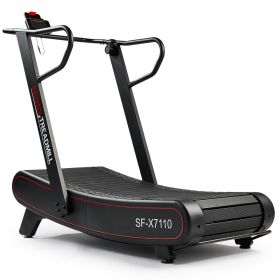
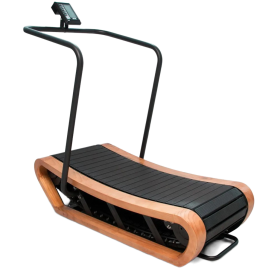


Curved Treadmill for Sale: Commercial-Grade Picks for Serious Training
Every curved treadmill for sale in this collection is built to outwork a motor—self-powered, slat-belted, and engineered for the kind of training that breaks ordinary treadmills. At Hamilton Home Fitness, we've curated this lineup for runners chasing sprint times, conditioning coaches building HIIT programs, and home buyers who want one machine that lasts a decade and trains everything from a fast walk to a full sled push. No underbuilt imports, no inflated "peak HP" gimmicks—only commercial-grade builds backed by real warranties and US-based support across all 50 states.
Why a Curved Treadmill Wins
A curved treadmill delivers a harder, more honest workout because you drive the belt—gravity, glutes, and posterior chain do the work a motor normally would. That single design choice changes the entire training experience.
Curved decks engage the hamstrings, glutes, and calves more aggressively than flat belts, encourage a forefoot strike, and reward proper running mechanics with smoother acceleration. Most users notice meaningful gains in cardiovascular load within the first session, and many independent guides report calorie burn 20–30% higher than motorized equivalents at matched pace.
Are curved treadmills worth the investment? For athletes, CrossFit affiliates, conditioning coaches, and anyone who plans to run hard for years, yes. The lack of a motor removes the single most failure-prone component on any treadmill, which is why curved units are routinely the longest-lived cardio piece in any well-run gym.
How Curved Treadmills Actually Work
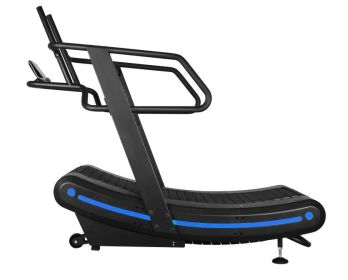
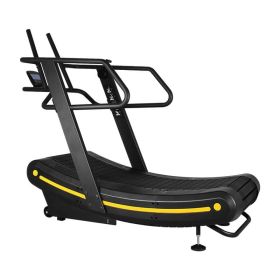
Curved treadmills replace a motorized belt with a slat belt riding on a concave aluminum or steel frame. As you push off the front of the deck, the belt rolls beneath you; pull your stride forward to slow down. There is no power cord, no speed dial, and no top-end limit other than your own conditioning.
That mechanical simplicity has real consequences. With no motor to burn out, no electronics to glitch, and no belt slip during sprints, a well-built curved treadmill becomes a ten-year-plus piece of equipment. Do curved treadmills need electricity? No—every model in this collection runs entirely on user power, which is why they're equally at home in basements, garages, and off-grid training studios.
Who Curved Treadmills Are Best For
A curved treadmill is the right buy when your training rewards intensity, variability, and biomechanical feedback—not steady-state pacing on a flat belt.
- Athletes training acceleration, top-end speed, or sprint repeats
- CrossFit boxes, F45-style studios, and conditioning gyms
- HIIT users running 20–60 second intervals with full recoveries
- Distance runners doing tempo work, hill sims, and form drills
- Recovery and rehab use under professional guidance—please confirm any return-to-run plan with your clinician
- Home buyers who want a one-machine gym that also accepts sled pushes and weighted carries
Are curved treadmills hard to run on for beginners? They demand more effort than a motorized treadmill, but the learning curve is short. Walk for two or three sessions before sprinting, hold the rails lightly during your first acceleration, and most users feel natural within a week.
How to Choose a Curved Treadmill
The right curved treadmill matches your training intensity, frame rating, and floor plan. Four decisions matter more than the rest.
Build Quality and Frame
Curved treadmills take a beating that motorized units never see—every foot strike drives the belt. Look for heavy-gauge steel frames, welded (not bolted) joints, and a tested user capacity of at least 300 lbs. Cheap curved imports skimp here and develop frame flex within months.
Slat Belt and Curve Radius
The belt and curve geometry decide how the machine feels. Rubberized slats over sealed bearings give the quietest, smoothest ride. A moderate front curve (roughly 8–10 degrees) suits the widest range of runners; steeper curves favor sprinters; gentler curves favor walkers and longer-form work.
Resistance and Console
Magnetic resistance lets you simulate hill work, sled pushes, and HIIT load without changing pace. A clean console showing speed, distance, time, calories, and heart rate is enough—avoid paying for unnecessary streaming services on a machine you bought for raw conditioning.
Footprint, Transport, and Floor
How much space does a curved treadmill need? Plan for roughly 70" × 32" of footprint plus 4–6 feet of clearance behind the deck for safe dismount. Most curved treadmills weigh 250–400 lbs and don't fold, so built-in handles and transport wheels are essential if you'll ever move the unit.
Warranty and Service
A real warranty separates a long-term asset from a disposable purchase. The brands in this collection publish frame, parts, and labor coverage in writing. Our full treadmill collection lists each warranty alongside the product so you can compare before you buy.
Key Selection Criteria
✅ Heavy steel-welded frame for daily use
✅ True commercial-grade slat belt deck
✅ Curve radius tuned for natural stride
✅ Magnetic or pin-based resistance levels
✅ User capacity of 300 lbs or higher
✅ Self-powered—no motor, no outlet
✅ Sled handle or push-bar compatibility
✅ Console with HR, speed, and distance
✅ Smooth, quiet bearings and rollers
✅ Wheels and grab handles for transport
✅ Lifetime frame and multi-year parts
✅ US-based warranty and service support
Curved Treadmills in This Collection
Each model in this curated lineup earns its place on a different training profile. How much does a quality curved treadmill cost? Expect to spend $2,200 to $11,000 depending on frame weight, slat quality, and feature set — and to recoup it many times over in years of use.
| Model | Best For | Starting Price |
|---|---|---|
| Ape Commercial Motorless Assault Runner | HIIT, conditioning, affiliate gyms | $2,299 |
| Assault Runner Curved Commercial (Blue) | Resistance training and sprints | $2,249.99 |
| Vortex CVX2500 Curved Treadmill | Home and light-commercial use | $2,799 |
| STEPR Tread Pro Plus + | Premium slat-belt home training | $5,999.99 |
| Spirit Fitness CTSBS900 Slat Belt Sled Treadmill | Full commercial and sled work | $10,999 |
For broader cardio context—ellipticals, rowers, bikes, and stair climbers that pair well with a curved deck—browse the full cardio equipment lineup, or explore STEPR's premium tread series for slat-style luxury builds.
Buying With Confidence
Every order ships nationwide from our Tennessee headquarters with insured freight, and we hold authorized-dealer status for every brand listed above—so warranties register cleanly under your name, and service claims route directly to the manufacturer. Free shipping applies to qualifying STEPR, Spirit Fitness, and Vortex orders.
Outfitting a full studio, garage gym, or commercial space? Pair your curved treadmill with our cross-training accessories or our commercial equipment lineup, and book a free gym design consultation so we can spec the layout, flooring, and supporting equipment around your new deck.
Ready to Train Without Limits
A curved treadmill is the closest you'll get to running outside without leaving home—harder, faster, longer-lasting, and entirely under your control. Choose the model that matches your training, lock in current pricing, and let our team handle shipping, setup guidance, and warranty registration end to end. Shop your curved treadmill above, or contact our team for a personalized recommendation—and start training on equipment built to outlast the workout.
Secure Payments