Introduction
If you want to box or train MMA at home, you need four things: a heavy bag, hand protection, a rhythm tool like a speed bag or double-end bag, and a couple of conditioning extras. The hard part isn't the workout—it's knowing which bag, what weight, which gloves, and how to set it all up without guessing.
This guide is for the home and garage crowd: the recreational boxer, the MMA fan, the hybrid athlete, or the parent setting up youth training. Combat-cardio at home keeps growing, but the gear only pays off when it actually fits your space and gets used every day.
By the end, you'll know exactly which bag and gloves to buy for your body and skill level, how to mount or place everything safely, and where to get a matched setup shipped anywhere in the US.
What a Home Combat Conditioning Kit Needs
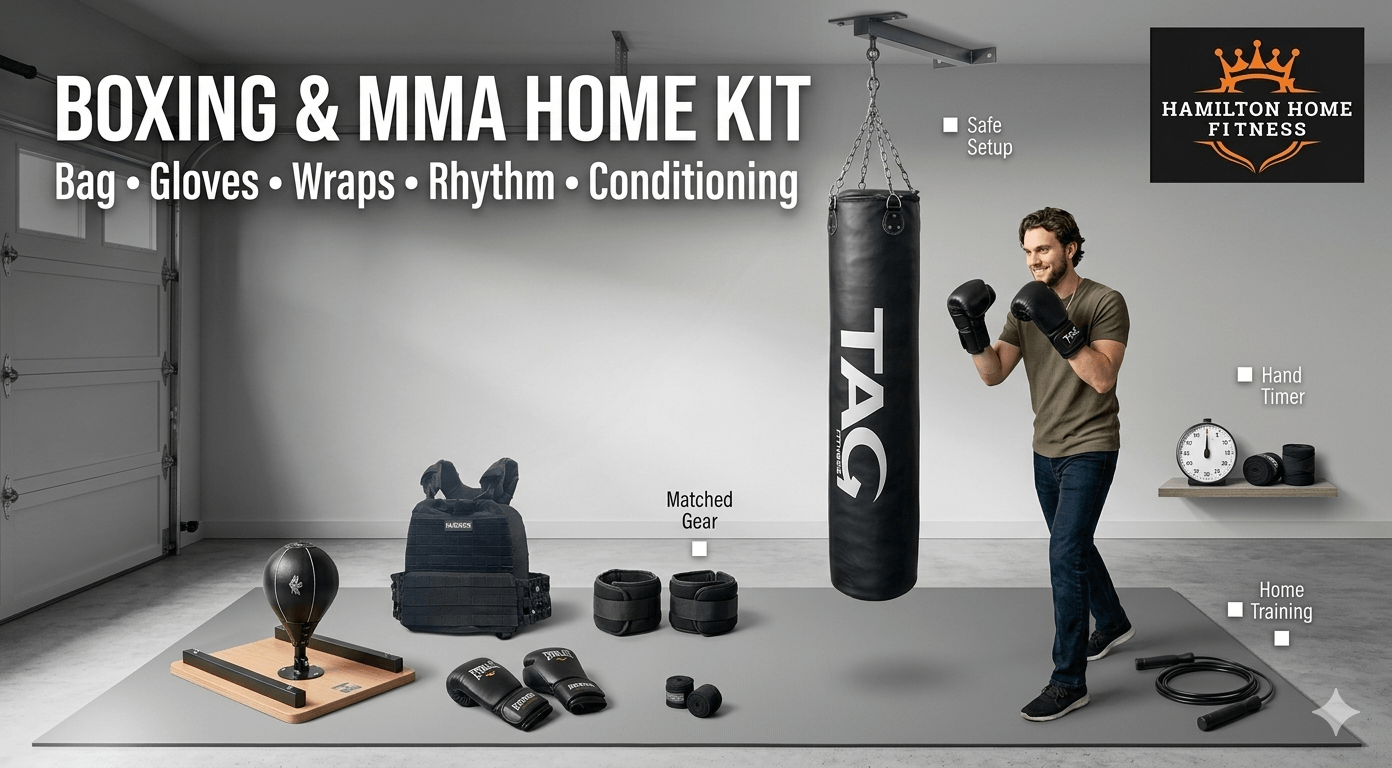
A home combat conditioning kit needs four things: one heavy bag (hanging or freestanding), hand protection (gloves plus wraps), a rhythm tool (speed bag, double-end bag, or both), and conditioning extras (a jump rope and a round timer). Everything else is optional. Start there, then size each piece to your space.
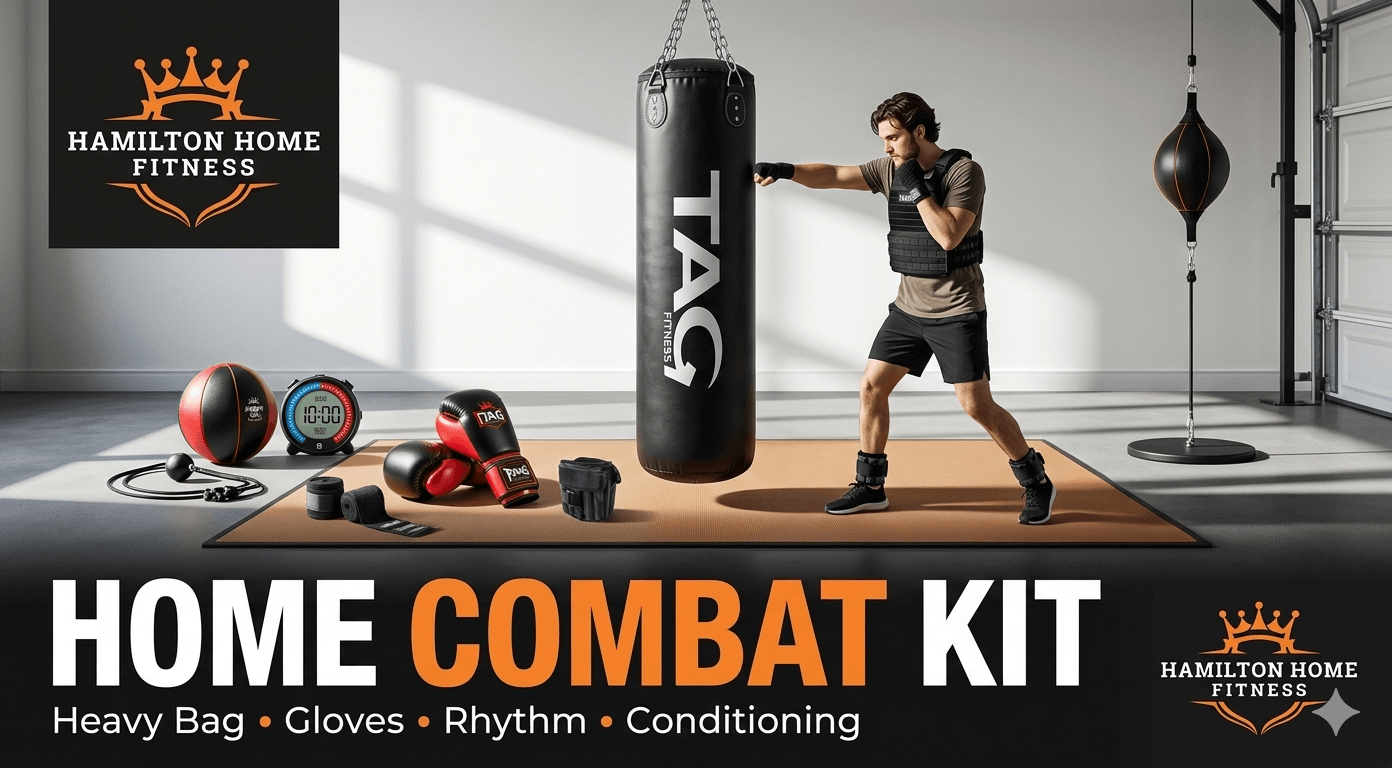
That's the whole frame. The heavy bag is your power and conditioning base. Gloves and wraps keep your hands and wrists safe under repetition. A rhythm tool builds timing and accuracy that bag work alone won't. The rope and timer turn equipment into an actual workout. Later sections size each one to your body, your space, and your goal—this is just the shape of the kit.
Starter kit vs full home setup
If you only buy three things, get a heavy bag, wraps, and one pair of bag gloves—that alone delivers a real conditioning workout. It's the minimum viable setup, and it's enough to train hard from day one.
From there, add by goal, not by impulse. Want sharper timing and reactions? Add a speed bag or double-end bag. Training with a partner? Add focus mitts or Thai pads. Chasing fat loss and harder conditioning? A jump rope and round timer cost little and do the most. Buy the base now and expand as your training tells you what's missing—that keeps a garage boxing setup affordable and uncluttered instead of a pile of gear you don't use.
Hanging vs Freestanding Heavy Bag
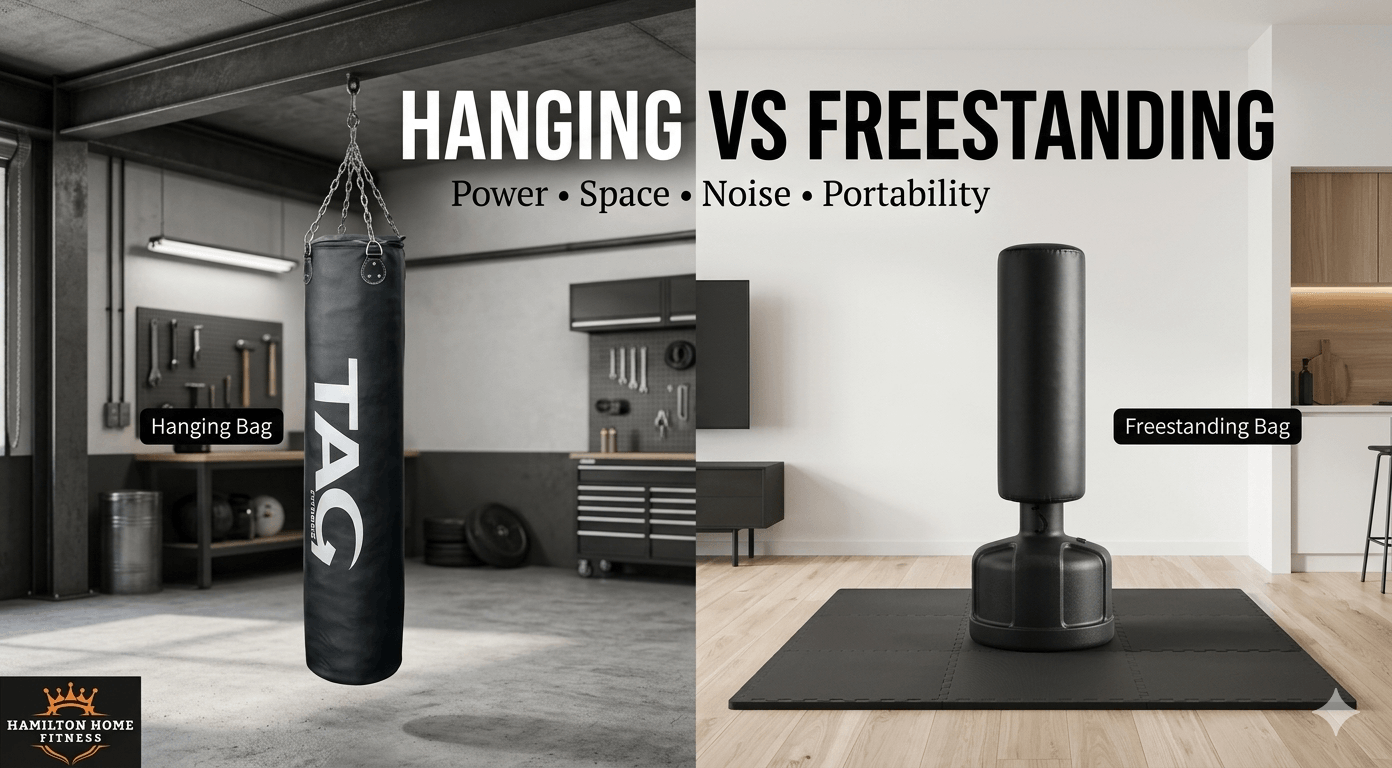
A hanging heavy bag gives better feedback, absorbs full-power punches, and lasts longer, but it needs a solid beam or stand. A freestanding heavy bag needs no mounting, moves room to room, and suits apartments and shared spaces, but it rocks under hard kicks. Choose by your space, your power, and whether the setup must be permanent.
Factor | Hanging heavy bag | Freestanding heavy bag |
Space | Needs swing clearance plus a mount point or stand | Fits a small footprint; nothing overhead required |
Feedback & power | Swings naturally and absorbs full-power punches and kicks | Softer feel, rocks back under hard shots |
Noise | Chain and impact noise, vibration through the mount | A weighted base can transmit vibration to the floor |
Setup effort | Drilling into a joist or beam, or assembling a stand | Fill the base and go—minimal setup |
Portability | Fixed once mounted | Moves room to room, even outdoors |
Cost | Bag plus mounting hardware or a stand | All-in-one, no extra mounting cost |
The choice comes down to three questions: Do you have a solid mount point or room for a stand? Do you hit at full power? Does the setup need to stay put or move? Your answers point clearly to one bag.
When a hanging bag works best
Choose a hanging heavy bag if you have a beam, joist, or stand and want realistic swing, durability, and full-power impact. Picture a dedicated garage corner with an exposed ceiling joist or a heavy bag stand bolted down. A swivel and chain let the bag rotate and swing after each shot, so your footwork and timing stay honest.
Power punchers and anyone drilling clinch work or full-contact combinations get the most here. A quality leather heavy bag built for this kind of use holds up to daily hard hitting—durability is where hanging bags earn their place.
When a freestanding bag fits
Choose a freestanding heavy bag if you can't drill, want portability, or share the space—fill the base with sand for more stability. When mounting isn't an option (a rental, a finished ceiling, or no usable beam), this is the alternative that still delivers real work.
The weighted base fills with water or sand; sand settles heavier and resists sliding and tipping better than water. A body opponent bag (BOB) adds a torso-shaped target for realistic head and body placement. Because it moves room to room and handles multiple users, it suits busy households, multi-user setups, and kids' boxing, where one bag serves everyone.
Apartment and noise concerns
For apartments, a freestanding bag on a padded mat keeps noise and vibration down for downstairs neighbors. Upper floors are the edge case where bag choice is really a noise choice. A freestanding bag set on a thick floor mat absorbs vibration before it reaches the unit below — the quiet bag setup most renters and multifamily gym users need. Skip the chain rattle of a hanging mount, keep sessions to reasonable hours, and a heavy mat handles most of the noise reduction.
What Heavy Bag Weight You Need
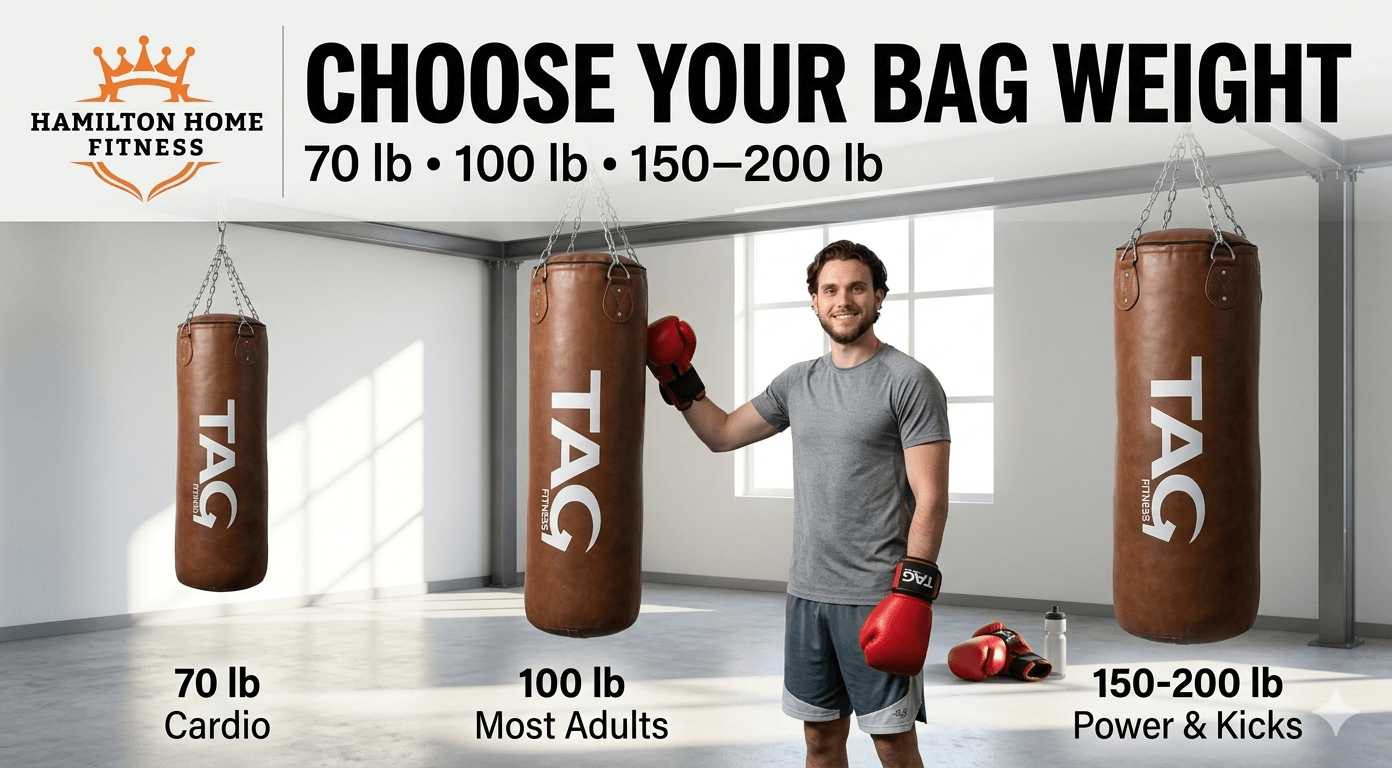
A common rule: pick a heavy bag roughly half your body weight. Most adults land on a 70–100 lb bag; heavier hitters and kickers prefer 100–150 lb, and dedicated power or commercial use runs 150–200 lb. Lighter, faster bags suit cardio and combinations; heavier bags suit power and resistance.
Your body weight | Beginner / conditioning | Intermediate | Advanced / power & kicks |
Under 150 lb | 70 lb | 70–100 lb | 100 lb |
150–200 lb | 70–100 lb | 100 lb | 100–150 lb |
Over 200 lb | 100 lb | 100–150 lb | 150–200 lb |
Bag weight by body and skill
A 70 lb heavy bag suits lighter or newer users; a 100 lb bag fits most adults; 150–200 lb is for heavy hitters and shared or commercial setups. Round up a tier if you kick hard or train Muay Thai—a heavier bag swings less and absorbs low kicks without sliding.
Specialty shapes change the math. A banana bag hangs longer and is angled for kicks and knees, and an uppercut bag targets close-range shots, so both can sit lighter than a standard cylinder while still doing their job. Buy for the level you'll reach in a year, not just today—a bag that's slightly too heavy still trains well, but one that's too light gets thrown around and wears out fast. Not sure which weight fits your space and goals? Contact our team for sizing help.
Water, sand, or synthetic fill
Fill changes the feel: synthetic and foam-filled bags are forgiving on the joints, while sand or water settles firmer over time. Closed-cell foam stays consistent and softer, which protects wrists during high-rep conditioning. Sand packs hardest and can develop a dense spot at the bottom; water sits between the two and spreads impact more evenly.
Match the fill to your hands and your hitting. New users and cardio-focused trainers do better with a softer synthetic or vinyl bag; power punchers who want firm resistance lean toward sand or a quality leather heavy bag. Whatever you choose, expect some settling in the first weeks—a firmer bag later is normal; a sagging one means the fill wasn't packed tight.
Gloves, Wraps, and Hand Protection
Yes—never hit a heavy bag barehanded for repeated work; wraps plus gloves protect your knuckles and wrists. For ounces, use 12–16 oz bag gloves for most adults, 16–18 oz for sparring, and lighter, faster gloves or MMA/hybrid gloves for pad and bag drills. Match the ounce to your use and your hand size.
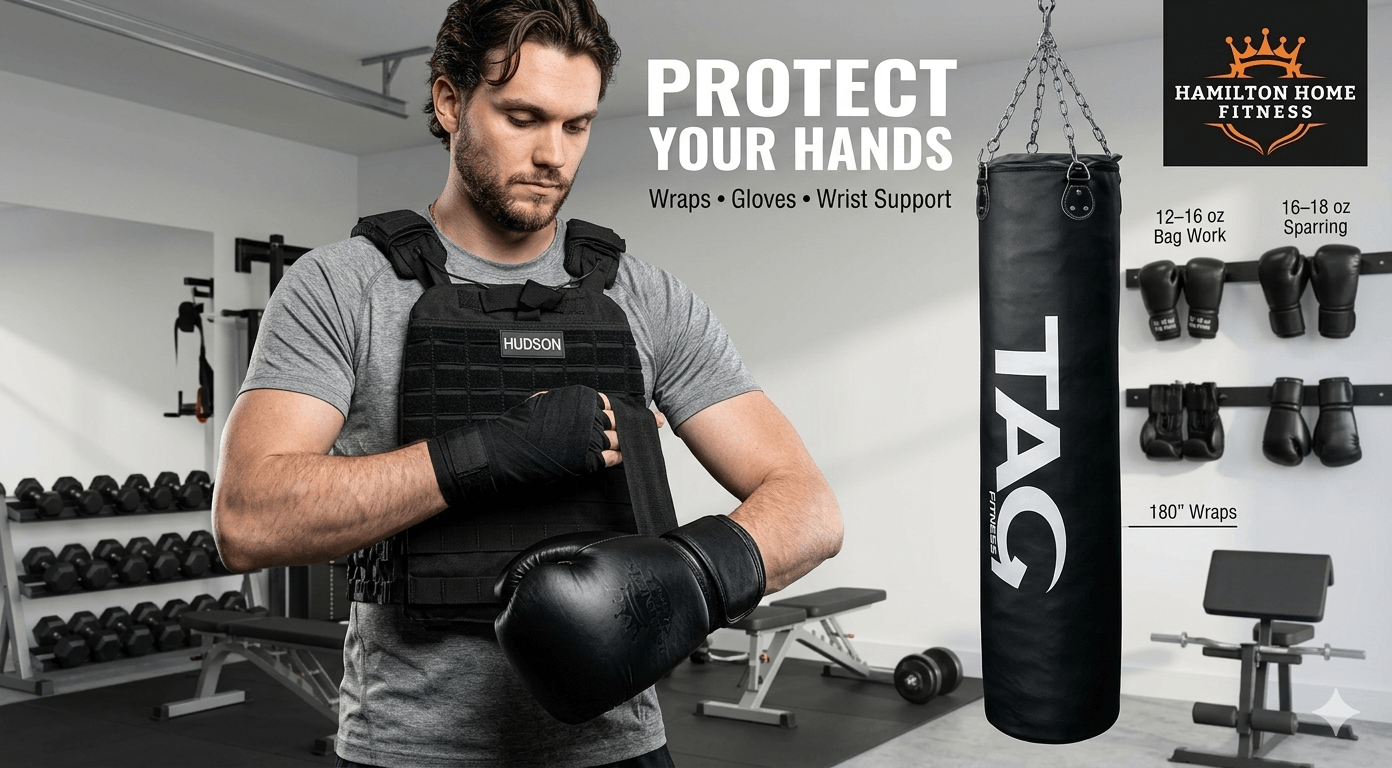
Your hands take the most abuse in any combat workout, and two pieces decide whether they hold up: the glove on the outside and the wrap underneath. Get both right and you train consistently; get them wrong and a sore wrist ends your week.
Glove ounce for each use
Use 14–16 oz for general bag work, 16–18 oz for sparring, and 8–12 oz hybrid or MMA gloves for fast pad and bag drills. The ounce isn't about toughness—it's about how much padding sits between your hand and the target and who's on the other end of it.
Training type | Smaller frame / women | Most adults | Larger / heavier hitters |
Bag work & cardio | 12–14 oz | 14–16 oz | 16 oz |
Sparring | 14–16 oz | 16 oz | 18 oz |
Pads & fast drills | 8 oz | 10 oz | 12 oz |
For solo conditioning, dedicated bag gloves or all-purpose training gloves cover everything you'll do. Sparring is where ounce matters most—heavier gloves protect your partner, not just you, so size up. If your home training leans toward MMA or fast pad drills, hybrid gloves or MMA gloves give you speed and an open hand while still padding the knuckles. Women's and kids' boxing gloves run lighter to fit smaller hands, so match the glove to the hand, not just the body weight.
Hand wraps and why they matter
Hand wraps stabilize the wrist and knuckles under every punch—180-inch wraps suit most adults, while gel wraps trade some protection for speed and convenience. Skipping wraps is the quiet mistake that catches up with people: the glove pads the impact, but the wrap is what holds your wrist and hand bones aligned.
Pick the length by hand size and the type by how you train. As an example, a smaller hand or a younger trainer fits a 120-inch wrap, while most adults need the full 180-inch length to cover the wrist properly. Traditional wraps lie flat; Mexican wraps have a little stretch and mold to the hand for a snugger fit. Gel wraps and gel knuckle guards slip on like a fingerless glove—fast and convenient, but they give less custom wrist support than a wrapped 180. If you add sparring later, a mouth guard and headgear become non-negotiable alongside the heavier gloves.
Speed Bags, Double-End, and Mitts
A speed bag builds timing, rhythm, and shoulder endurance through a repeating rebound. A double-end bag trains accuracy, hand speed, and head movement because it moves unpredictably. Focus mitts and Thai pads need a partner to develop combinations and power. Pick the speed bag for rhythm, the double-end for reactions, and pads for partner work.
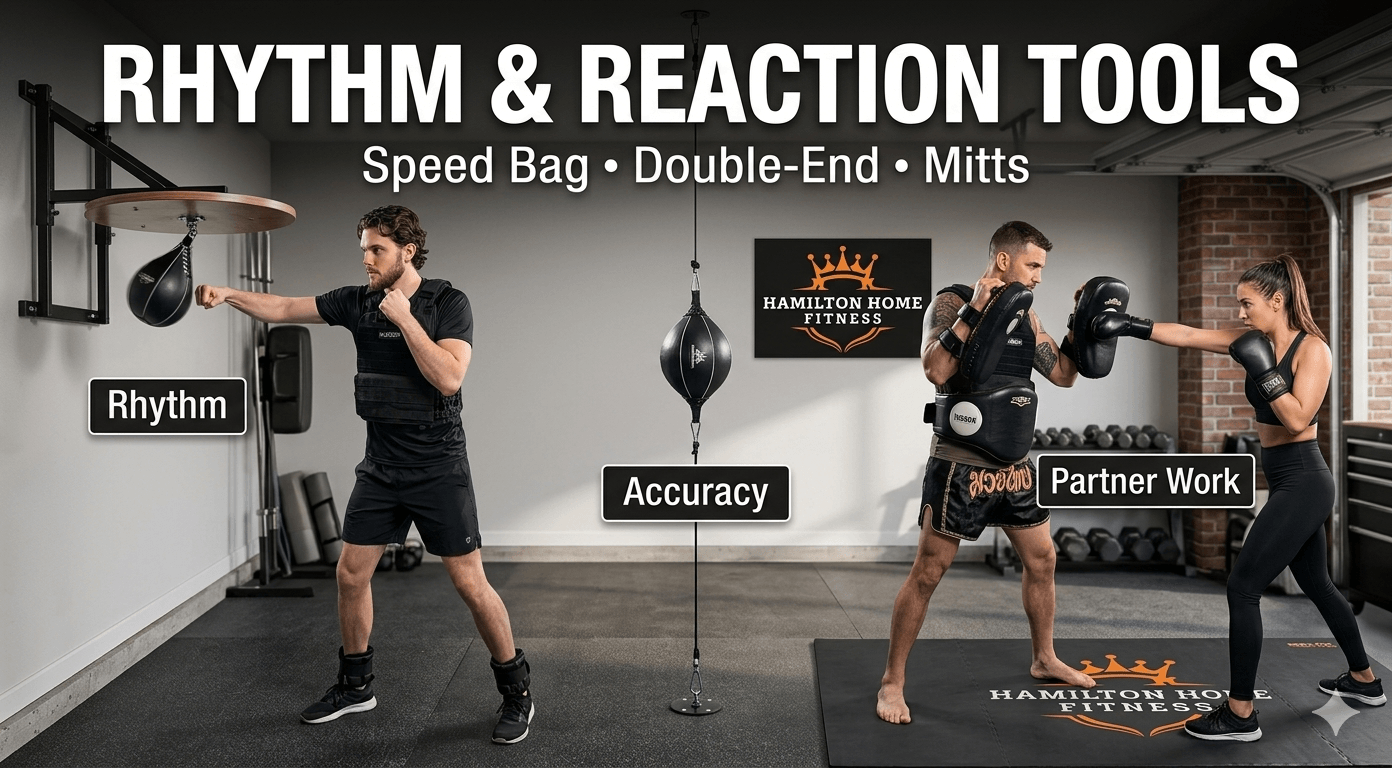
The heavy bag builds power, but it won't sharpen your hands or your eyes. That's what the rhythm and partner tools add—and which one you buy depends entirely on whether you train alone or with someone.
Speed bag vs double-end bag
Choose a speed bag for rhythm and timing; choose a double-end bag for accuracy and reaction speed—many home setups eventually add both. They train different things, so the right pick follows the skill you're after.
Speed bag | Double-end bag | |
Skill trained | Timing, rhythm, shoulder endurance | Accuracy, hand speed, reactions, head movement |
Solo difficulty | Steep rhythm learning curve early on | Easy to start, harder to control |
Space & mounting | Wall- or platform-mounted, fixed spot | Anchored floor-to-ceiling, needs swing room |
A speed bag setup means a mounted speed bag platform with a swivel, and the rebound off the drum is what trains the repeating rhythm—frustrating for a week, then addictive. A double-end bag anchors top and bottom and snaps back on its own line, so it punishes a sloppy punch and rewards a clean one. If head movement is your goal, a slip bag or reflex bag adds the slip-and-roll work, and a Maize bag angles for the same defensive timing. Most home trainers start with one and add the other once they feel what's missing.
Focus mitts and Thai pads
Focus mitts and Thai pads are for partner training — get them if a training partner or coach is part of your home setup. Solo, they sit in a corner; with a partner, they unlock combinations, power, and timing you can't get off a bag.
Say a friend or your kid holds you on weekends. Focus mitts (focus pads) are for boxing combinations and speed—quick hands and sharp punches called on the move. Thai pads are built heavier for kicks, knees, and elbows, which makes them the core of Muay Thai and kickboxing conditioning. A kick shield takes hard low kicks and teeps when you want full power, and a belly pad lets the holder absorb body shots safely. Buy these only when a partner is part of the plan—otherwise the money is better spent on a rhythm tool you can use alone.
Does Bag Work Replace Cardio?
Yes — structured bag work can match or beat steady running for conditioning and fat loss when done as timed rounds or intervals, and it adds coordination, upper-body work, and stress relief that running doesn't. The key is intensity and round structure, not just time on the bag.
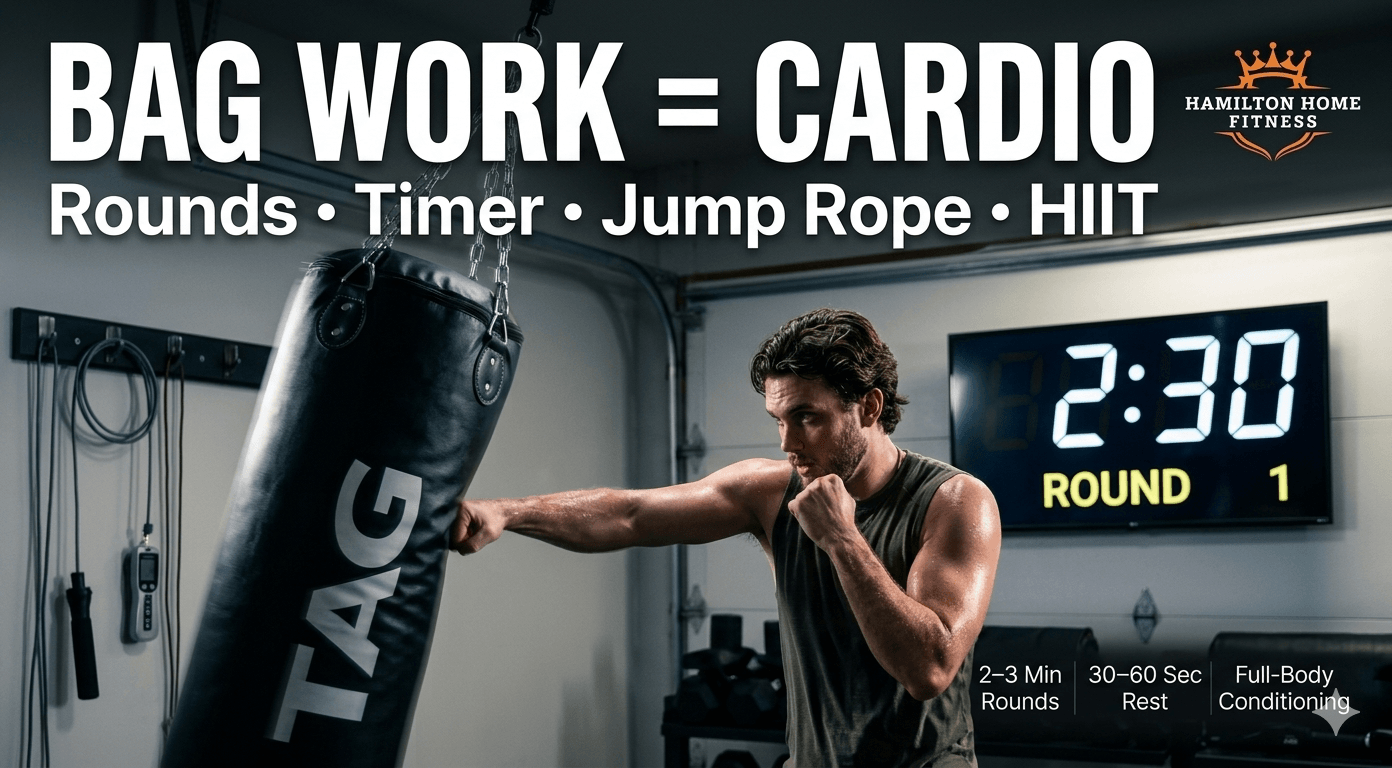
The difference is how you train it. Drifting at the bag for twenty minutes burns less than a focused run. But timed rounds with real effort push your heart rate the same way intervals do — with the bonus of sharpening hands, shoulders, and footwork at once. A simple session looks like this:
Warm-up: 2–3 minutes of rope or shadowboxing
Rounds: 6–12 rounds of 2–3 minutes on the bag
Rest: 30–60 seconds between rounds
Finisher: a few rope intervals or bodyweight work
Effort inside each round is what drives the result. Hit hard, move between shots, and keep rest short, and the bag does everything a cardio session does.
Rounds, timers, and jump rope
Run timed rounds — a round timer keeps you honest, and a jump rope adds high-intensity conditioning between bag rounds. Without a clock you slow down without noticing; with one, every round holds its intensity. Use this checklist to turn gear into a real program:
Set a round timer to a 3-minute round with a 1-minute rest or a 2-minute round for faster intervals—a dedicated gym timer or interval timer beats glancing at a phone.
Open and close with the rope. A light-speed rope builds quick feet; a weighted rope adds upper-body conditioning. Even 3-minute rope rounds between bag work raise the intensity that drives fat loss.
Add HIIT-style finishers. Alternate 30 seconds all out on the bag with 30 seconds rest for the last few rounds.
Mix in skill drills. Slip-rope boxing trains head movement on the rest, so recovery still builds a skill.
Match the structure to your sport. Boxers run more rounds; BJJ and wrestling conditioning lean on shorter, harder bursts that mirror a scramble.
A clock and a rope cost little and do the most to make a home setup deliver. To stock the ropes, timers, and conditioning tools that turn your bag into a full program, browse our conditioning and bodyweight gear.
Set Up and Buy Your Bag Safely
Mount a hanging bag only into a solid structure—a ceiling joist, a load-rated beam, or a dedicated stand—using proper lag bolts or an eyebolt. Never drywall alone. Plan a clear footprint with swing room, and remember heavy bags often ship by freight, so confirm delivery and access before ordering.
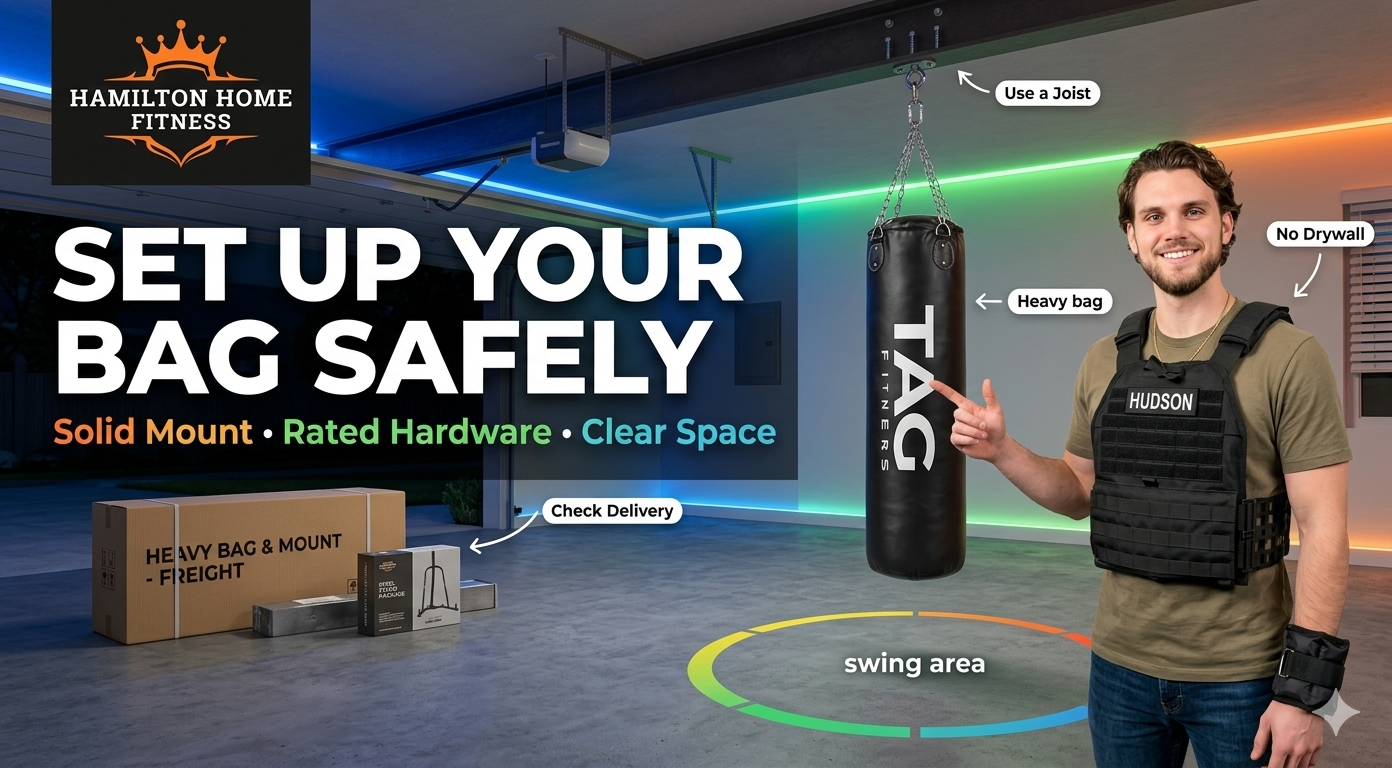
A safe mount comes down to a short checklist:
Find solid structure. Locate a ceiling joist or a load-rated beam — drywall, a finished ceiling, or a single screw won't hold a swinging bag.
Use rated hardware. A heavy-duty eye bolt or lag bolts driven into the joist, plus a swivel so the bag rotates instead of twisting the mount.
Check the load rating. Hardware and mount should rate well above your bag's weight to handle the force of a hard punch, not just the static hang.
Clear the footprint. Leave swing clearance on all sides so the bag never hits a wall, a car, or the ceiling at its full arc.
No mount? Use a stand. A freestanding heavy bag stand gives you a rated anchor with no drilling.
Safety note: Ceiling mounting carries real risk if the structure can't take the load. If you're unsure whether your joists or beam can hold a heavy bag, have a qualified contractor or structural professional confirm it before you drill.
Mounting in a garage or basement
Anchor into a joist or beam with rated hardware; if you can't, use a freestanding stand instead of risking drywall or a weak mount. Most failed setups trace back to the same mistakes, so avoid these: bolting a heavy bag ceiling mount into drywall instead of a joist, skipping the stud finder and guessing, using a hook rated for far less than the bag, leaving out the swivel so the chain kinks, and forgetting a heavy bag spring or swing clearance so the bag clips a wall. A heavy bag wall mount works only when it lands in solid framing, not just the surface. Get the anchor right or use a stand—there's no safe middle ground. If you'd rather have the footprint and hanging hardware planned for you, book a free gym design session.
Freight and nationwide delivery
Heavy bags and stands often ship by freight rather than standard parcel, so check delivery access and any free-shipping eligibility before you buy. This is the edge case people forget: a 100 lb bag or a steel stand isn't a small box on a doorstep. Freight delivery may stop at the curb, may need a clear path for residential delivery, and timing differs from parcel shipping. As a Tennessee boxing equipment supplier offering USA nationwide shipping, we can confirm what your order needs before it leaves. Check the shipping and freight details so there are no surprises on delivery day.
Build a Complete Everlast Setup
Once you've chosen a bag type, weight, gloves, and a rhythm tool, build them as one matched kit instead of mismatched parts. Everlast covers the full range — bags, gloves, wraps, speed bags, ropes — at home and commercial levels, which makes a complete, consistent setup simpler to assemble and ship to one address.
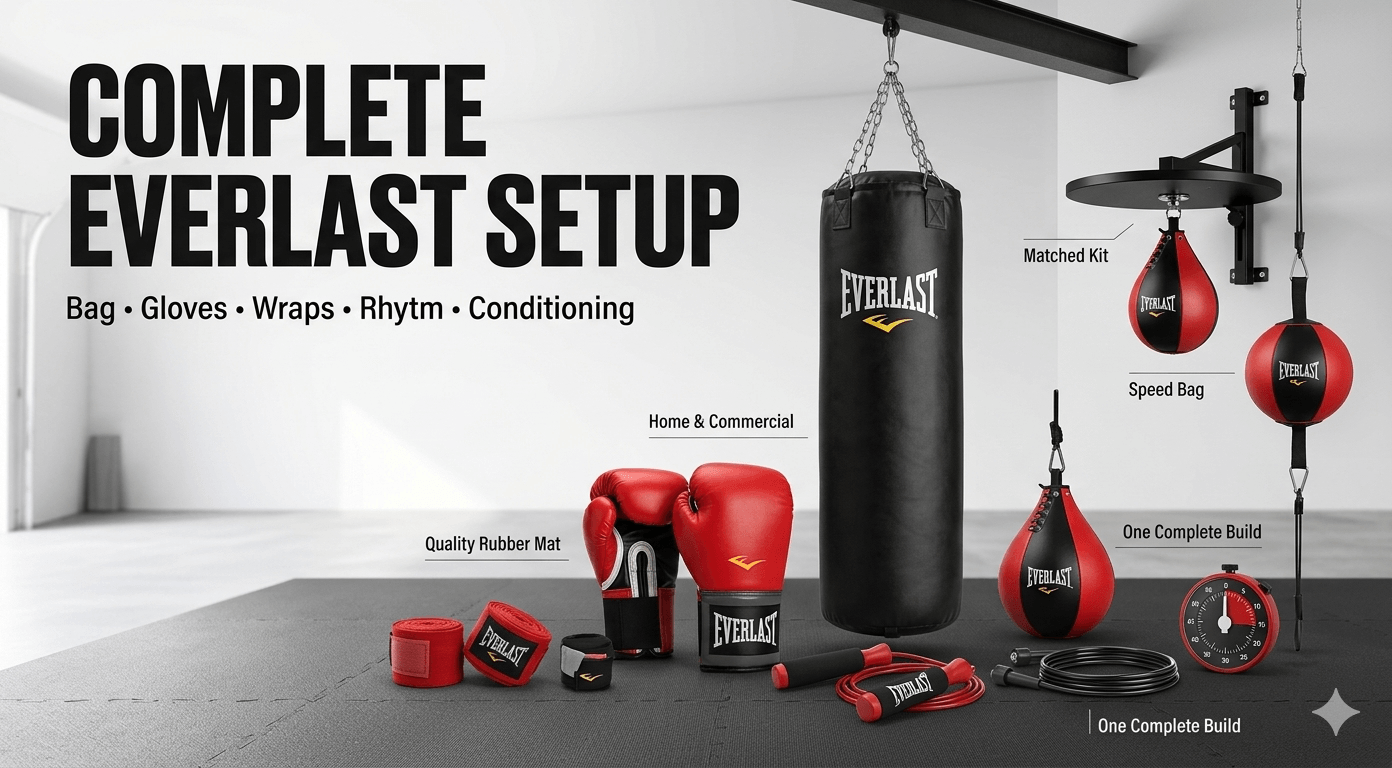
Buying piece by piece from different places is how people end up with a 16 oz glove that doesn't suit their bag or a rope that outlasts a flimsy timer. A matched build avoids that. A complete home setup usually looks like this:
Heavy bag sized to your body weight and skill
Bag gloves in your use-case ounce, plus hand wraps
One rhythm tool — speed bag or double-end bag
Jump rope and a round timer for conditioning
Are Everlast heavy bags good? For home and commercial conditioning, they're a durable, widely available option with a wide model range—pick by weight and fill for your training, not by name alone. The point isn't a single "perfect" bag; it's a setup where every piece fits the next. To assemble a matched build and ship it to one address, browse the Everlast home boxing collection.
Outfitting a gym or team
For studios, teams, or corporate wellness, standardize a core kit and a replacement cycle so shared gear stays consistent and hygienic. Picture a kickboxing studio or an after-school youth program: every station needs the same bag, glove, and wrap setup, and shared equipment has to hold up to daily use across many hands.
That's where buying as a standardized set pays off. A consistent kit means every athlete trains the same way, a planned replacement cycle keeps worn gear out of rotation, and a clean-and-rotate routine handles the hygiene that shared gear demands. The same logic scales to a multifamily gym, a corporate wellness gym, or sports teams ordering in bulk. For larger or facility builds, start with our commercial gym equipment.
FAQ
Are Everlast heavy bags good?
Yes, for both home and commercial conditioning. Everlast offers a wide range of durable, widely available bags, so choose the model by weight and fill that matches your training rather than by the brand name alone.
Do you need gloves to hit a heavy bag?
Yes. Use bag gloves with hand wraps to protect your knuckles and wrists—hitting a heavy bag bare-handed for repeated work risks injury to the small bones in your hands.
Can boxing replace running for cardio?
It can match or beat steady running for conditioning and fat loss when you train in timed rounds or intervals, and it adds coordination and upper-body work that running doesn't. Many people combine both for variety.
How long should a home boxing workout be?
About 20–40 minutes of rounds suits most home conditioning — for example, 6–12 rounds of 2–3 minutes with short rests. Intensity matters more than total time.
Final Thought
You now know which heavy bag and gloves fit your body and your space, how to mount or place them safely, and how to get a matched setup shipped to your door. The rest is just deciding what to buy first.
Build around your goal and your space, not around buying everything at once. Start with the bag, gloves, and wraps that match how you train, then add a rhythm tool, rope, and timer as your sessions show you what's missing.
When you're ready, assemble your matched kit from the Everlast collection at Hamilton Home Fitness — or, if mounting and footprint are your open questions, book a gym-design session and let your garage or basement layout be planned around the bag from the start.