Introduction
Four tabs open, four machines, and every one of them calls itself a complete home gym.
The model codes don't help. A universal trainer, a functional trainer, and a multi-station gym can look nearly identical in a product photo, then train you in three different ways.
This all-in-one home gym machine comparison puts four units from BodyKore, Body-Solid, Vortex, and TAG Fitness side by side on what actually decides the purchase: stations, resistance, footprint, and price.
If you're buying for one household, you'll know which unit fits your room by the end. If you're sizing one machine for a studio floor or a wellness room, the section on simultaneous users is the one to read first.
Universal, Functional, or Multi-Station?
A functional trainer runs cables only. A universal trainer adds a Smith bar and rack to those cables. A multi-station gym uses fixed-path stations built for more than one lifter. Format follows user count and lift style, not price.
Functional trainers suit people who train movement rather than maximum load. Rotational work, single-arm pressing, and controlled patterns around an old shoulder—all of it runs off adjustable pulleys. They are the wrong call if you want to squat or bench heavy, because there is no bar and no rack to catch it.
Universal trainers are what you buy when one machine has to cover everything. Cables, a guided bar, and rack positions in a single frame let a solo lifter press and squat hard without a spotter. The cost is floor space. These are the largest units in the category, and they punish a room you measured optimistically.
Multi-station gyms earn their place when two people train at the same time. Fixed stations let a beginner and an experienced lifter work in parallel without resetting anything between sets. For a solo buyer, the same budget buys more capability in a different format.
Is a functional trainer better than a multi-gym? Neither wins outright. One gives a single user more movement variety; the other gives several users simultaneous access. Count your users first. If you want the type-level breakdown of stack sizes and cable systems before comparing specific units, compare all-in-one home gym machines on the subcategory page.
The Four Units Side by Side
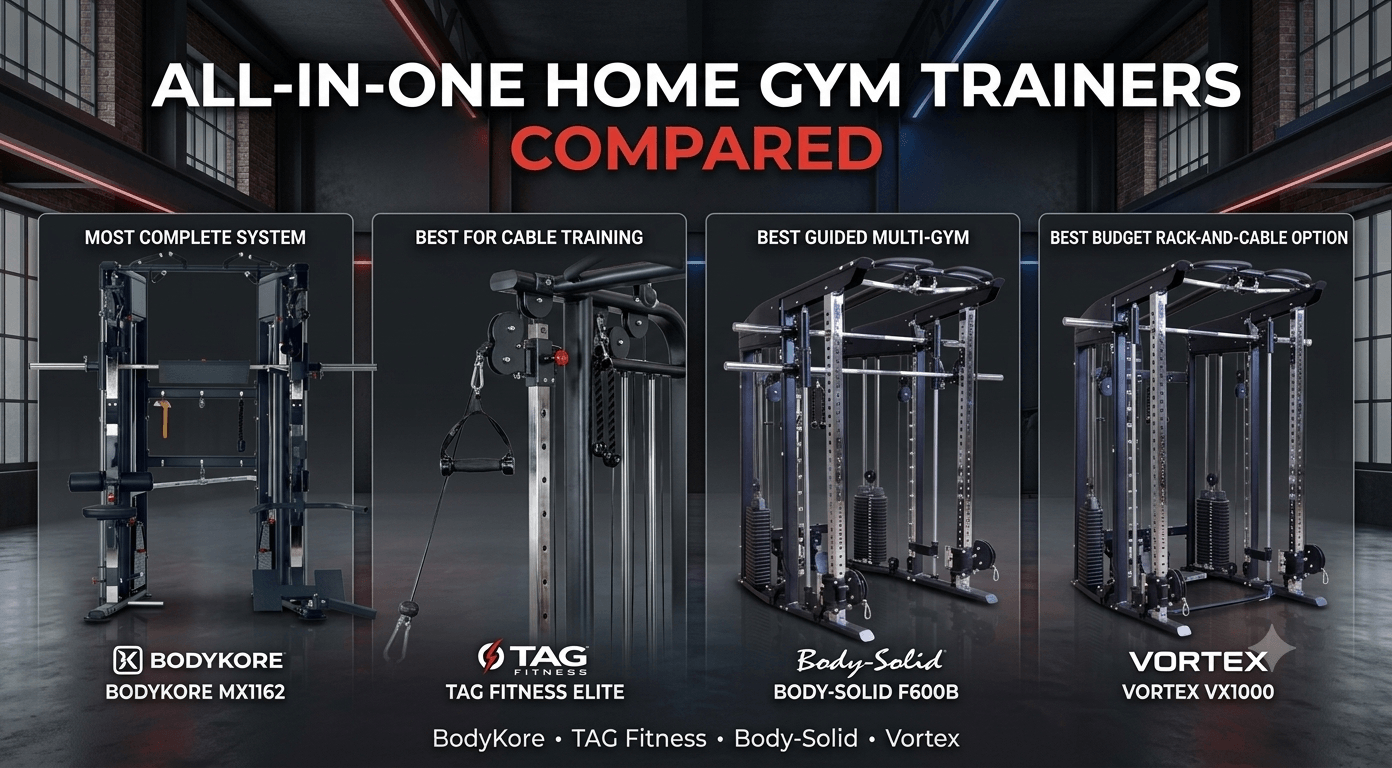
Four units, four different jobs. The BodyKore MX1162 packs the most stations into one frame. The TAG Fitness Elite is a pure cable trainer. The Body-Solid F600B builds around seated, guided stations. The Vortex VX1000 is the cheapest way to get a rack and cables in the same footprint.
Unit | Resistance | Stations | Best-Fit Buyer | Price |
2 × 220 lb stacks, upgradeable to 340 lb | Smith, dual cables, half rack, pull-up, dip, leg press, landmine | One machine doing everything | $6,999 | |
Stack weight to confirm | Dual adjustable pulleys | Cable-first training, no bar work | $5,499.99 | |
210 lb stack | Bi-angular press arm, leg curl and extension, pulldown, articulating cable arms | Seated, guided stations | $4,145 | |
Stack weight to confirm | Power rack, Smith, cable crossover, plate storage | Rack and cables on the lowest budget | $3,299 |
Prices are current at publication—check each product page before ordering.
The spread from $3,299 to $6,999 buys stations and stack capacity, not better steel. All four are commercial-rated frames. What the extra money gets you is breadth: the MX1162 replaces four separate purchases, while the VX1000 replaces two and leaves the seated isolation work to something else.
Dual Stacks or Plate-Loaded Resistance?
Dual-weight stacks give instant selection and let two people work the cables independently. Plate-loaded resistance gives a higher ceiling and cheaper expansion. Stack size matters less than whether the stack can grow—stack expansion means adding weight to the stack you already own rather than replacing the machine.
A stack that stops at its printed number is a harder limit than it looks. The MX1162 ships with two 220 lb stacks and takes an upgrade to 340 lb, which lifts the ceiling without touching the frame. The F600B runs a 210 lb stack. Those figures sit close together on paper. In practice, one has somewhere to go.
Plate-loaded resistance works the other way around. You load Olympic plates onto the bar or rack, so the ceiling comes from the frame rating rather than a stack, and expanding costs the price of plates instead of a manufacturer upgrade kit. The trade is speed and storage — changing weight takes longer between sets, and the plates have to live somewhere.
Choose stacks if you train fast, share the machine, or want nothing else to buy. Choose plate-loaded if your five-year ceiling sits above any stack on offer.
Will It Fit Your Room and Ceiling?
Measure the usable floor, add clearance on every active side, and then check the ceiling height against the pull-up bar. Floor space is rarely what stops a purchase. Ceiling height is usually.
Measure in this order:
Usable floor. Length and width of the clear floor, not the room's dimensions. Subtract anything you won't move.
Active-side clearance. Two to three feet on every side you'll stand, step back, or pull a cable from.
Ceiling height. Floor to the lowest obstruction—joist, light fixture, garage door track—not the highest point.
Delivery path. Doorway width, stair turns, and landing space. Freight arrives curbside.
The MX1162 sets the upper end of these four at roughly 40 sq ft, about 91" × 62" × 89". That last number is the one to check first. An 89" frame needs assembly clearance above it and standing room above that for pull-ups, which is where a basement with 8-foot joists quietly disqualifies itself.
Measure before you order. A machine that won't clear the ceiling is a freight return, not an exchange.
Training Two or More People at Once
Dual independent stacks let two people work the cables at the same time. A Smith bar or rack station is single-user regardless of how many stacks the machine carries. Simultaneous capacity comes from independent stations, not from total weight.
Picture a 6 a.m. window with two people and one machine. On the MX1162, one trains cable rows on the left stack while the other runs pressdowns on the right—no waiting, no reloading. The moment one wants the Smith bar, the other stops. Two 220 lb stacks buy parallel cable work, not a parallel machine.
That distinction decides studio and wellness-room purchases. A functional trainer with dual stacks serves two clients concurrently and nothing more. A multi-station gym separates users by station, so a trainer can run a client on the press while a second person works legs—genuinely independent, at the cost of a much larger footprint. Count how many people need to be mid-set at the same moment, then buy for that number rather than for the household total.
Which One Should You Actually Buy?
There is no single best all-in-one machine. There is a best one per buyer, and the four here split cleanly by what you need the frame to do.
Buy the MX1162 if one machine has to replace four. It's the only unit here with a Smith bar, cables, a rack and a leg press in one frame — and the wrong buy if your ceiling is under about eight feet or your budget stops before $7,000.
Buy the TAG Elite if you train cables and nothing else. It's wrong for anyone who wants to load a bar heavy, because there isn't one.
Buy the F600B if you want seated, guided stations and a smaller footprint. Its single 210 lb stack is the ceiling, so it's wrong for a lifter already pressing near that.
Buy the VX1000 if you want a rack and cables at the lowest entry price. It's wrong if you expected the seated isolation stations; the other three carry in some form.
Browse the BodyKore range, Body-Solid strength equipment, TAG Fitness equipment and Vortex Strength machines to see what else each brand builds around these units.
Freight, Quotes, and What Ships Free
All four units ship by freight, and three of the four brands ship free.
Body-Solid, TAG Fitness, and Vortex equipment ships free nationwide from Tennessee. BodyKore freight is quoted by size and destination. Delivery is curbside—the driver puts the pallet on the ground and leaves. Plan two people and several hours for assembly on any of these frames.
Some brands skip checkout entirely. Hoist private-invoice models are quoted per order rather than sold through a cart, which is standard for commercial lines and means ordering starts with a conversation.
FAQ
Which of these units still needs a bench, plates, or attachments bought separately?
The VX1000 needs Olympic plates for its rack and Smith side, plus a bench for pressing. The stack-based units arrive with resistance built in, though a bench widens what any of them do.
Which models require a freight quote rather than online checkout?
All four compared here are available through checkout. Private-invoice brands such as Hoist and Matrix Fitness are quoted per order instead, which is standard for commercial lines.
Do all-in-one machines replace free weights?
For general strength, largely yes—pressing, pulling, squatting, and isolation all run off one frame. They don't replace loaded barbell work or conditioning, so plan those separately.
Are commercial-grade home gym machines worth the price?
For daily, shared, or long-horizon use, yes. A commercial frame in a home runs far below its rated duty cycle. Cables and upholstery are the wear items, not frames—and both are replaceable.
How much should you spend on a home gym machine?
These four run $3,299 to $6,999. Judge that against the separate stations the unit replaces—a rack, a cable tower, and a leg station bought individually usually cost more.
Final Thought
The right unit isn't the one with the most stations. It's the one matched to how many people use it, how much ceiling you actually have, and where your strength will be in five years.
The expensive mistake is buying for the room you wish you had. Measure the one you've got first.
Still deciding? Talk it through with our team and we'll size the machine to your space and your users. Fitting out a full room rather than adding one machine? Book a gym design consultation and have the layout mapped before anything ships.