Introduction
You've picked a weighted vest. Now you're choosing between one weight for good and a vest you can load up over time. In the adjustable weighted vest vs. fixed decision, the cheaper-looking option can be the one you buy twice.
For most buyers who'll progress or share a vest, adjustable is worth it. But only a plate carrier truly grows. Packet vests stop at the weight on their label.
Below, we compare each system for a solo trainee planning to progress, a two-person household, and a small studio. Every price comes from a real listing in the Hamilton Home Fitness catalog, as of September 2026.
What Separates Fixed and Adjustable Vests?
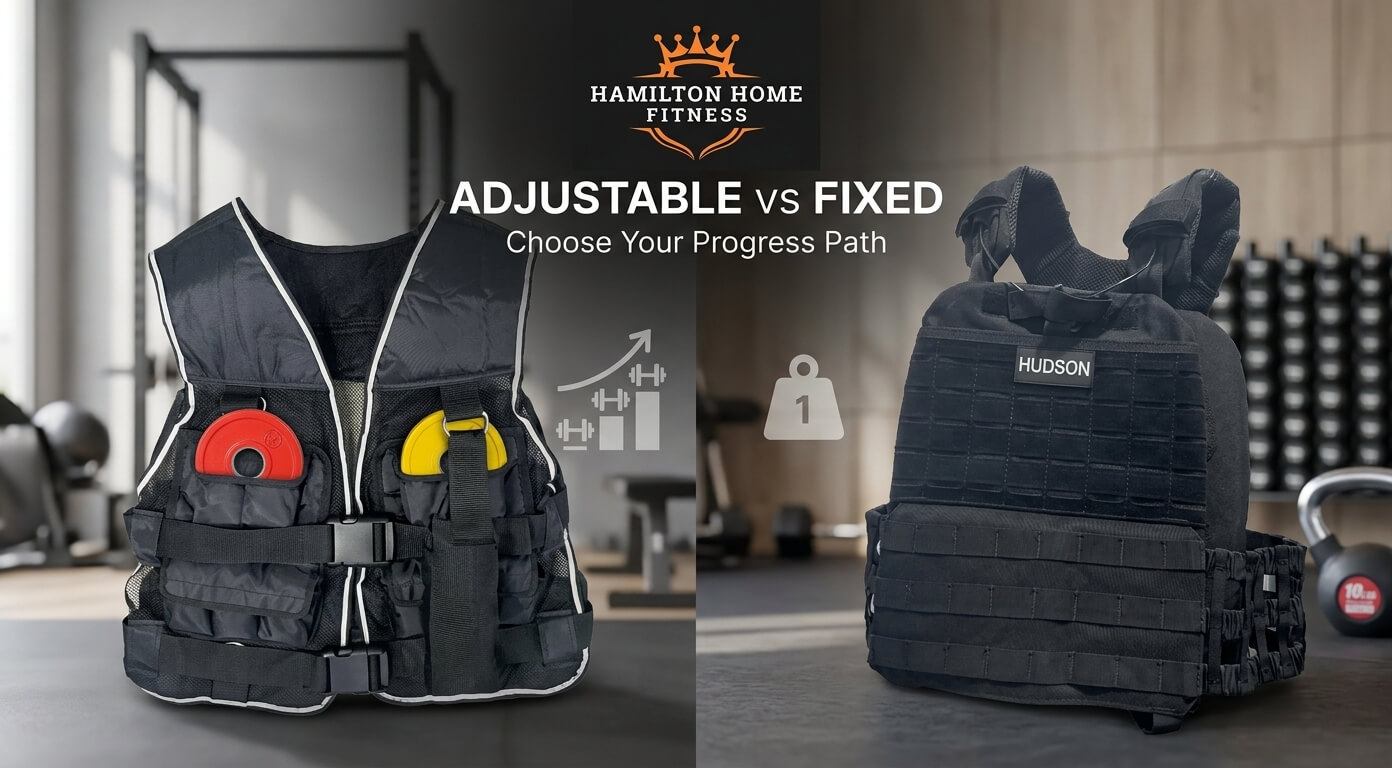
A fixed-weight vest has its load sewn in. An adjustable vest lets you add or remove weight. In any adjustable weighted vest vs. fixed comparison, "adjustable" means two systems with opposite limits. Packet vests cap their weight range at the label. A plate carrier's range grows with the plates you add.
Packet Vests Stop at Their Label
A packet vest adjusts up to the weight on its label and stops there. Neither stocked brand lists extra bags.
Apollo's 20 lb adjustable vest with 1 lb sandbags ($51.15 as of September 2026) suits a walker or beginner staying under 20 lb. If you're growing into a heavier vest, you'll outgrow this one. Body-Solid's sandbag vests don't publish their step size.
Plate Carriers Grow With Plates
A plate carrier's load grows with the plate sets you add, so it isn't capped at purchase.
The Hudson plate-loaded weight vest ($199 as of September 2026, sold by private invoice) suits someone building toward heavy rucking or hero WOD loads. Its listing publishes no capacity or sizing, so ask before you order.
Fixed-Weight Vests Hold One Number
A fixed-weight vest has its fill sewn in, so the load you buy is the only load it will ever carry. Outgrow it, and only its resale value offsets a second vest.
The York Weighted Vest listing ($70 as of September 2026) publishes no load or format, so confirm both before ordering.
What Does Each Path Cost in Total?
In this catalog, the lowest-priced vest is adjustable: the Apollo 20 lb at $51.15. Doubling capacity at purchase adds $10.83 with Apollo and $30 with Body-Solid. Upgrading later instead costs an extra $51.15 to $120.
Best value by cost per pound. Prices as of September 2026.
Vest | Price | Maximum load | Cost per lb of capacity |
Apollo 20 lb | $51.15 | 20 lb | $2.56 |
Apollo 40 lb | $61.98 | 40 lb | $1.55 |
Body-Solid BSTWVP20 | $120.00 | 20 lb | $6.00 |
Body-Solid BSTWVP40 | $150.00 | 40 lb | $3.75 |
Hudson vest | $199.00 | Not published | Not calculable |
Body-Solid is the only vest brand here that ships free.
Buying 20 lb now, 40 lb later
Buying a 20 lb packet vest and upgrading later costs more than buying a 40 lb capacity up front: $113.13 versus $61.98 with Apollo and $270 versus $150 with Body-Solid.
Apollo's 40 lb version of the same vest suits budget home training. Its home-use listing and 6-month warranty make it a poor fit for facilities.
The Body-Solid 40 lb premium vest fits when price isn't the deciding factor.
Picking 20 lb for a small frame? Confirm fit first, since neither brand says whether the 40 lb shell sits bulkier.
The Plate Path: Shell Plus Sets
The Hudson plate path starts at $199 for the vest. The lightest plate set adds $25, and the heaviest Hudson plate set adds $79. One of all four sets brings the total to $381.
Vest plate cost can't be broken down per pound, because the listings don't say how many plates a set holds.
This path suits someone passing 40 lb who'd rather pay as they progress. It's wrong if you want one known total up front.
How Small Should Each Load Step Be?
Step size matters in proportion to body weight. For a 120 lb user, a 1 lb sandbag is under 1% of body weight. The lightest vest plate listed, at 3.5 lb, is about 3%, and more if it's set to hold two plates.
Heavier users feel the same load increments less. At 200 lb, a 1 lb bag is 0.5% of body weight. The lightest vest plate is 1.75%. That's why vest plate increments suit a heavier progression path better than a light start.
The finest steps matter most for:
Lighter or smaller-framed users
New starters building from a low load
Older adults progressing slowly
If you have back, joint, or heart concerns, clear any load change with a clinician first.
Carrier or Sandbag Vest: Which Wears Better?
Sandbag vests flex with the torso and suit movement-heavy work. Plate carriers hold rigid slabs that sit steady for walking and rucking but feel stiffer on the floor and overhead. Both wear at seams and closures, not at the weight itself.
No stocked listing publishes heat or lifespan data, so these points are general.
Bulk, Heat, and Bounce
Rigid plates press flat against the chest and back, while sandbags mold to the torso. Bounce, though, depends more on a snug strap fit than on the fill.
Body-Solid says its sandbags conform to the body. That closer profile suits floor work, pull-ups, and presses.
Heat follows fabric coverage, not fill. Snug every strap before judging either system.
Seams, Leaks, and Lifespan
Weighted vests wear out at their seams, pocket closures, and hook-and-loop straps. The weight itself rarely fails, though a sand packet can split where a rigid plate cannot.
Sewn fill has no closures to fail but is hard to repair. In a carrier, the pockets wear before the plates.
Warranty terms back durability under load unevenly: Apollo lists 6 months, and the Body-Solid and Hudson listings publish none.
The return terms for unused gear give you 30 days, so check these on arrival:
Stitching at the shoulder seams
Pocket closures that hold shut
Straps that grip when pulled
Packets with no leaking fill
One Vest for Two People or a Studio?
Adjustable vests suit multiple users better, because each person resets the load in seconds. Fit is the harder part. No stocked vest publishes a size chart, so two very different frames should confirm the strap range before ordering.
Two People, Two Body Sizes
Two people can share one adjustable vest if its straps close snugly on both frames, say partners at 130 lb and 210 lb.
Body-Solid's commercially rated 20 lb vest relies on two wide Velcro straps and lists no sizes. It suits a couple sharing light loads, but not a partner training above 20 lb.
Studios and Shared Class Sets
For a studio, the rating matters more than the ceiling. Body-Solid's 20 lb listing states commercial and residential ratings. Apollo's says home use, and Hudson's lists none.
The Body-Solid range ships free, which adds up across a class set, but its vests don't take rigid plates.
Modular vest loading lets one class set cover every level. To size that set, plan a studio layout with our team.
When Does a Fixed-Weight Vest Win?
A fixed-weight vest wins when one load will cover the next year for one person, and simplicity matters more than range. In this catalog it doesn't win on price, because the lowest-priced vest in stock is adjustable. For buyers who expect to progress or share, adjustable is worth it.
Fixed-weight vest pros outweigh the cons when:
One person uses one steady load for a year
There's nothing to adjust, lose, or refill
You mostly run, where bounce matters most
The load is already confirmed as enough
The running point is general: sewn fill can't shift inside pockets, though no stocked listing measures bounce.
When the goal shifts to heavy strength work rather than loaded movement, dumbbells and other free weights do the job better.
FAQ
Can you add weight to a weighted vest?
Yes, if it's adjustable. Packet vests take weight up to their label. Plate carriers take more with each plate set. Sewn-in vests can't. No spare sandbags are listed here.
What is the best weighted vest for beginners?
A beginner vest should start light and step finely, like a 1 lb bag system. A common first load is about 5% of body weight. Back, joint, or heart concerns? See a clinician first.
Do vest plates fit other weighted vests?
Not by default. The four plate sets are Hudson's own, listed for its vest. Nothing on the listings says they fit Apollo or Body-Solid pockets, so ask before ordering from the Hudson Steel range.
How do you clean a weighted vest?
Empty the weight pockets, clean the shell as its care label directs, and dry it fully before reloading. Removable weights are what make a washable weighted vest. Sewn-fill vests take spot-cleaning only. No stocked listing gives care steps, so this is general.
Final Thought
Buy the load system that matches your next year, not the load that feels right today. Compare our weighted vests and plates side by side. Body-Solid ships are free, and Hudson orders run through private invoices.
Questions before you order? Ask about sizing or plate fit. We're an authorized dealer shipping from Tennessee to all 50 states.