Introduction
Your adjustable bench just arrived. You know it does more than a flat press, but standing over it, you're not sure what else.
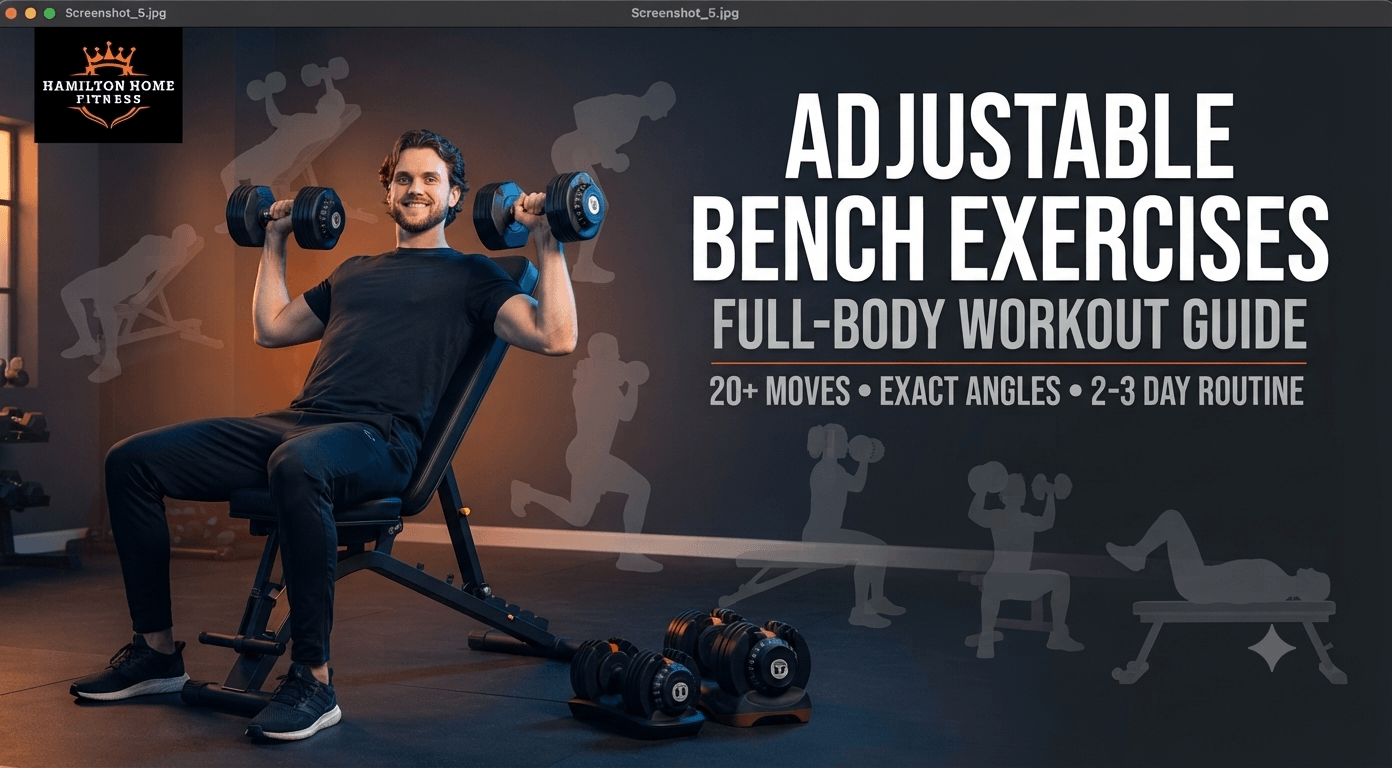
Here's the short answer: One adjustable bench and a pair of dumbbells train your whole body. The adjustable weight bench exercises below hit chest, back, shoulders, arms, legs, and core—with no rack, no cables, and no machines.
Your problem was never the equipment. It's knowing which moves to do, at which angle, and how to sequence them into a routine.
This guide fixes that. You'll get the full movement list, the exact bench angle for each, a weekly split you can run alone, and an honest rule for how heavy to go when no one's there to spot you.
Can one bench and dumbbell train it all?
Yes. One adjustable bench and a pair of dumbbells cover every movement pattern your body needs — press, row, hinge, squat, and core. Changing the bench angle turns a small set of dumbbell moves into more than 20 exercises, reaching chest, back, shoulders, arms, legs, and core with no rack, no cables, and no machines.
A flat bench keeps you horizontal — you press and row on one plane, and that's it. An adjustable bench changes that. Tilt the back pad up for incline and overhead angles and drop it below flat for decline, and each setting shifts the load to a new muscle. Same two dumbbells, far more range.
The full-body movement map, with angles
Set the bench to match the muscle. Chest presses want a flat or a 30° incline, and the lower chest wants a −20° decline. Shoulders press near-vertical, around 75–85°. Rows and most arm work sit flat or at a low incline. The table below maps every dumbbell movement to its angle, so you never have to guess a setting.
Body part | Key movements | Bench setting |
Chest | Dumbbell press, fly, pullover | Flat and 30° incline; −20° decline for lower chest |
Back | Chest-supported row, single-arm row | 30° incline with chest on the pad; flat for single-arm |
Shoulders | Seated press, lateral raise, rear-delt fly | Near-vertical (~75–85°); incline with chest on the pad for rear delts |
Arms | Incline curl, skull crusher, bench dip, close-grip press | 45–60° for curls; flat for the rest |
Legs & glutes | Bulgarian split squat, step-up, hip thrust | Flat pad, with your rear foot or upper back braced on the bench |
Core | Decline sit-up and crunch, lying leg raise, feet-elevated plank | Decline for sit-ups; flat for the rest |
A few settings aren't obvious, so here's the reasoning.
For shoulders, press near-vertical rather than straight up. A small backward lean loads the front delts (the anterior deltoid) while the pad supports your spine. Going fully vertical drops the chest out of the lift and puts the shoulder joint in a weaker, riskier spot.
For the upper chest, 30° is the sweet spot. That shallow incline shifts work onto the upper fibers of the pectoralis major without turning the press into a shoulder exercise, which is what happens once you climb past 45°.
Face back, rest your chest on the pad at 30°, and row from there. Bracing your torso takes your lower back out of the equation—no hinging, no holding a bent-over position under load. That matters most when you train alone, because your lats do the work instead of your spine.
Which moves need decline and a leg hold
Two movements need the bench below flat: the decline dumbbell press for the lower chest and decline sit-ups or crunches for the core. Both also need a leg hold-down—the padded rollers or foot pegs that pin your legs so you don't slide off on the descent. Many budget "adjustable" benches skip both.
This is where benches split. Plenty of "adjustable" benches only tilt up—flat and inclined, never below level. A true FID bench—flat, inclined, and declined—drops past flat, and that's what makes lower chest presses and decline core work possible.
So if decline matters to you, confirm the bench has it before buying. The BowFlex 5.1S, for example, locks to a −20° decline. For decline sit-ups, also look for foot anchors that hold your feet in place.
A weekly routine you can run alone
Train your whole body two to three times a week, with a rest day between sessions. Two days suits beginners; three suits anyone recovering well. Each session pairs a press, a row, a lower-body move, and a core move, working mostly in the 8–15 rep range that builds muscle.
Day | Movements | Sets × reps |
Day 1 | Incline press · chest-supported row · Bulgarian split squat · seated shoulder press · decline sit-up | 3 × 8–12 (core 2 × 12–15) |
Day 2 | Flat press · single-arm row · step-up or hip thrust · incline curl + skull crusher · lying leg raise | 3 × 8–12 (core 2 × 12–15) |
Rest 60 to 90 seconds between sets, a little less on the smaller arm and core moves. Pick loads that leave you near failure by the last rep but still under control.
Then progress. Add a rep each session, and once you hit the top of the range on every set, move up in weight. That slow climb — a rep here, a few pounds there — is progressive overload, and it's what actually drives growth week to week.
This is where load range matters. Lateral raises need light dumbbells; split squats and rows need much heavier ones. A dumbbell set with a usable weight range covers both ends, so no movement is capped by the wrong weight.
For three days a week, run Day 1, then Day 2, then Day 1 again next session, alternating—every session still trains everything.
Training alone: what load to stop at
Train alone, and your press ceiling is the weight you can safely bail out of—not the most you can lift once. On any overhead or chest press, leave two or three reps in reserve, and choose a load you could set down on your chest or lower to your sides if a rep stalls. If you can't escape it, it's too heavy.
Know your exit before the set. On a flat dumbbell press, a failed rep means bending your elbows to bring the weights to your chest, then rolling up to sit—never letting them drop straight down. On a seated overhead press, it means lowering the dumbbells back to your shoulders under control. Rehearse that escape with a lightweight so it's automatic when you actually need it.
One more habit: keep the floor around the bench clear, so if you do have to ditch a dumbbell to the side, nothing's in the way.
This is general guidance, not a substitute for coaching. If you're new to lifting, coming back from an injury, or unsure of your form, work with a qualified trainer or check with your doctor before pushing your loads up.
Building muscle and outgrowing dumbbells
Yes, you can build real muscle with only a bench and dumbbells. Growth comes from tension on the muscle, effort taken close to failure, and adding load over time—not from machines. A dumbbell press and a barbell press grow the chest the same way if the effort and progression are there.
What changes is the ceiling. Dumbbells stop being enough when your heaviest pair no longer challenges a movement, and your legs hit that wall first. Split squats and step-ups outrun a mid-weight dumbbell set long before your chest or arms do, because your lower body is simply stronger.
So upgrade in order. Heavier or adjustable dumbbells come first — they keep every movement in this routine working, and they're the cheaper, smaller fix. The moment you want to load a real squat or press beyond what you can safely hold in each hand, that's when you add a power rack and a barbell, so heavy work has catch bars behind it.
Most home lifters get months of steady progress before any of this comes up. Add equipment when a movement stalls, not before.
FAQ
What bench angle is best for a shoulder press?
Near-vertical—about 75° to 85°, just short of straight up. That slight backward lean keeps your front delts working while the pad supports your spine. Going fully vertical drops the chest out of the lift and strains the shoulder joint.
Do you need a rack if you have an adjustable bench?
Not for this routine. Dumbbell presses, rows, split squats, and core work need no rack at all. You only need one when you move to heavy barbell squats and presses, where catch bars keep a failed rep from landing on you.
How many exercises can you do with just dumbbells and a bench?
Comfortably 20 or more. The bench's angles multiply a small set of dumbbell moves into flat, incline, decline, seated, and supported variations, reaching every major muscle group from one setup.
Is an adjustable bench better than a flat bench for home workouts?
For most home lifters, yes. A flat bench handles horizontal pressing well, but an adjustable bench adds incline, decline, and seated angles—so one piece trains far more of the body without taking up more floor space.
Final Thought
You now have what you came for: a full-body movement set, the exact angle for each lift, a split you can run alone two or three times a week, and a safe rule for how heavy to go without a spotter. That's the real point of an adjustable bench—one piece stands in for a press station, an incline and decline station, a row support, and a core anchor, which is why it earns its footprint. When you're ready to match a bench to this routine, it's worth seeing the adjustable benches Hamilton Home Fitness carries.